 blck
blck 2026-09-15
I gave an old Notion idea to a tiny team of agents
Space View was supposed to be a space toy. It became my crash course in multi-agent development.
I have a Notion table for project ideas. It is a peaceful place where good intentions go to take a very long nap.
One of its residents was Space View: an Earth-centred little universe with the Moon and asteroids passing nearby. No launch date. No business plan. Just a note that sounded fun when I wrote it down.
I picked it up because I wanted to learn multi-agent development, and a space visualisation felt like the right kind of problem: interesting enough to keep me awake, complicated enough that I could not pretend one giant prompt would magically make it good.
You can open Space View and play with it here.
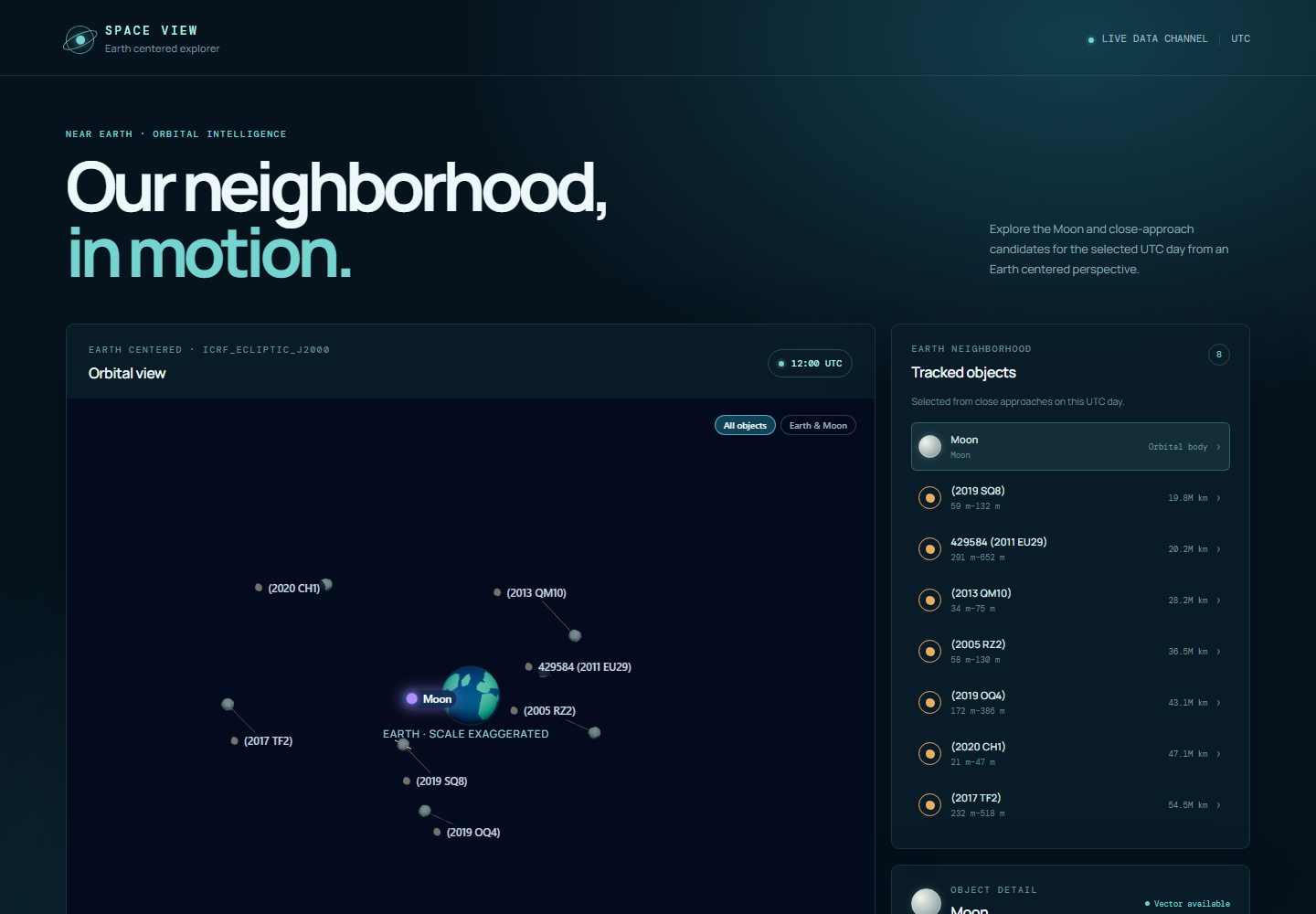
Space View on desktop, with the Moon and close-approach candidates around an exaggerated Earth.
First lesson: agents love a vague task a little too much
At the start I had the classic ambitious instruction: build a website that shows the Moon and nearby asteroids. That is how you get several very enthusiastic people all walking in roughly the same direction while carrying different maps.
So I had to become much more specific. One piece owned NASA and JPL data. One piece owned the API shapes. One built the Three.js scene. One handled controls and the friendly bits around it. Suddenly the work stopped feeling like “make the space thing” and started feeling like a sequence of things that could actually be checked.
The surprisingly important thing was a boring little shared contract. Earth is the centre. Times are UTC. Positions are kilometres. Every object gets the same coordinate transform. Asteroids use real sampled paths, not the sort of elegant spaghetti orbit that looks great until you remember it is completely made up.
Then came the awkward hand-offs
Agents are very good at finishing the task they were given. They are less naturally good at noticing that their perfectly reasonable answer has made somebody else’s task weird.
That was the actual learning curve: reading the plan, checking the seams, and asking annoying questions early. Is this date still UTC? Does this number still mean kilometres? What happens when one upstream request fails? Is “potentially hazardous” about a classification, or are we accidentally telling people a rock is coming for them?
The answers mattered more than flashy features. The Moon still appears when there are no asteroid encounters. One broken trajectory does not make the whole scene disappear. The API key stays on the server. The app does not invent data just to make the screen look more dramatic.
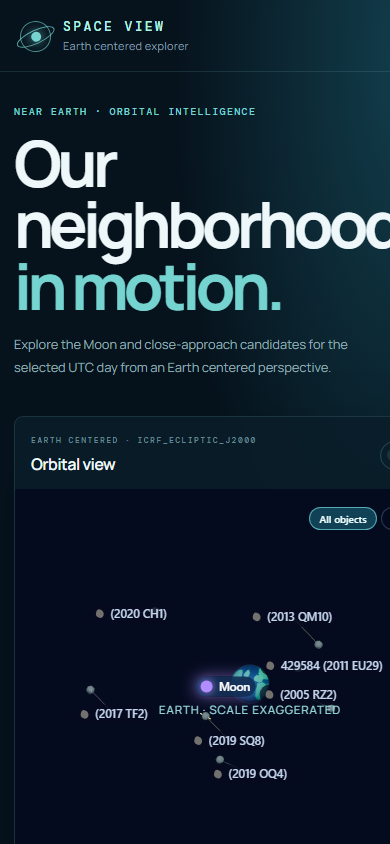
The same idea, squeezed into a phone-sized viewport.
The nice part
Once the work had clear boundaries, the agents were genuinely fun to work with. Progress became visible. A backend task could be tested without waiting for the final interface. The frontend could use a synthetic scene while live providers were still being wired up. Bugs had somewhere to live instead of floating around as a general feeling that “space is broken.”
It also made me appreciate the human job in the loop. I was not handing over judgement; I was learning where judgement matters most. The plan, the contracts, the review of the joins between parts — that is the work that keeps a multi-agent project from becoming a very fast way to produce confusion.
Back to the ideas table
Space View escaped Notion and became a real, working project. More importantly, it gave me a much better feel for how to develop with multiple agents: give them a real problem, split it at the seams, and keep one eye on the story the finished thing is telling.
In this case, the story is that our neighbourhood is always moving. The other story is that I now have one fewer excuse for the next idea in that table.